
Key findings
- The most consequential town-centre projects to 2029 will be those that turn prominent vacant buildings into regularly used service, community, cultural or commercial anchors—not those that pursue retail reoccupation as an end in itself.
- Public capital can resolve parts of the viability gap, but it cannot substitute for ownership control, a committed end user, affordable operation and reliable access. These are the principal delivery risks for the Derelict Buildings Fund period.
- Evaluation evidence supports targeted intervention, but not simple claims of causation or a universal retail-revival model: Future High Streets Fund places saw stronger footfall recovery, while longer-term economic effects remain unproven.
- Centres should be segmented by their economic role and catchment. The appropriate anchor may be health, learning, workspace, public services, culture or leisure; it need not be a replacement retailer.
- By autumn 2027, secured assets, delivery contracts, committed occupiers and funded operating plans will be more meaningful indicators of progress than launch announcements, longlists or national vacancy headlines.
The thesis: the next regeneration test is dependable use, not visible refurbishment
England’s town-centre policy is moving into a delivery-heavy phase. *Hope on the High Street* frames the problem as one of structural change in retail, vacancies, public assets, safety, access and local leadership. Its immediate capital mechanism is the £125 million Derelict Buildings Fund (DBF), allocated across 60 English local authorities within the wider £210 million Community Assets Programme (Ministry of Housing, Communities and Local Government, 2026) ↗ ↗.
That matters now because town centres are being asked to carry more than retail demand. They remain places for shopping, but also for services, employment, social infrastructure, hospitality and, in many cases, housing. The government reports that English footfall remains below pre-pandemic levels, while vacancy remains material and online retail continues to account for a substantial share of sales (Ministry of Housing, Communities and Local Government, 2026) ↗. These conditions do not imply that every high street is in irreversible decline. They do, however, make a return to historic retail occupancy an unreliable organising objective for public investment.
Sanctuary’s central judgement is that the strongest schemes between 2027 and 2029 will convert a limited number of strategically important empty buildings into anchors that generate repeat use across the week. An anchor may be a health, education, employment, cultural, community or leisure use; in some locations it may be a commercially viable mixed-use proposition. The defining feature is not the label. It is whether the use has a credible source of recurring demand, a viable operating model and a realistic relationship with the surrounding centre.
This is a narrower and more demanding ambition than “reviving the high street”. It accepts that some legacy retail floorspace will not return to retail use. It also avoids the opposite error of treating any conversion as progress. A refurbished building that opens briefly, operates at a loss or fails to draw people into the centre can consume scarce capital without improving local economic value.
**Base case:** DBF-backed activity produces visible improvements and a stronger project pipeline in a number of places, but results are uneven. Assets with an occupier, manageable abnormal costs and a funded route to operation create sustained use; others complete feasibility work or enabling activity without reaching durable occupation.
**Upside case:** capital support is combined with public-estate decisions, service commissioning, transport access and a capable operator. Several assets then move together, increasing confidence for nearby businesses and making the town centre more useful to residents.
**Downside case:** capital is committed before demand and operating risk are resolved. Legal, heritage, utilities or contamination constraints absorb budgets, and completed spaces remain underused. The distinction is consequential: it separates regeneration as a construction programme from regeneration as a durable economic and social proposition.
What existing evidence supports—and where it stops short
The case for intervention is stronger than anecdote, but it needs disciplined interpretation. The final Towns Fund evaluation found that Future High Streets Fund locations had footfall 6.7% higher than comparable towns. In the third quarter of 2025, funded towns had recovered to 97.9% of their 2019 monthly footfall, compared with 91.3% among non-funded comparators. It also found a statistically significant 3.8 percentage-point improvement in pride in place in selected case-study towns where schemes were visible and designed around resident needs (Ministry of Housing, Communities and Local Government, 2026) ↗.
These are meaningful intermediate outcomes. Footfall can support local traders; visible, resident-focused improvements can change perceptions; and targeted public action can help places recover. But the evaluation does not establish that any specific physical intervention causes lasting local growth. It was too early to assess longer-term economic activity effects ↗. Nor is footfall a sufficient outcome in its own right. A centre may attract more visitors while seeing weak business survival, low-quality employment, inaccessible services or limited local spending retention.
The structural trend supports adaptation rather than a retail-only target. Office for National Statistics analysis shows that retail employment in Great Britain’s central high streets fell by 19% between 2015 and 2024, while accommodation and food-services employment rose by 18%. It also records that residential addresses account for more than half of land use in central high streets, and that around one fifth of Great Britain’s population lives on or around a high street (Office for National Statistics, 2026) ↗.
The appropriate conclusion is not that retail no longer matters. Retail remains central to the attractiveness and convenience of many centres, and poorly designed non-retail conversion can weaken active frontages and evening safety. Rather, a town-centre strategy should ask what mix of uses can support activity throughout the day and week in that particular location. The performance test should include reliable access to useful services, sustainable occupation, business vitality and inclusive use—not just a narrower vacancy rate or a short-lived footfall uplift.
Why asset assembly and operation are the binding constraints
The DBF timetable makes 2027 a practical test of local delivery capacity. Authorities are expected to develop longlists and undertake community engagement by the end of 2026, submit progress updates by April 2027, begin delivery in spring 2027 and receive tranche-one delivery funding in April to June 2027 where progress and engagement requirements are met (Ministry of Housing, Communities and Local Government, 2026) ↗. The important leading indicators will therefore appear before construction is visible: asset control, feasibility, governance, prospective occupation and a costed route to operation.
This focus reflects the nature of persistent vacancy. DBF guidance identifies fragmented ownership, unclear title, heritage costs and misaligned owner incentives as barriers to bringing derelict buildings back into use ↗. Funding for acquisition, restoration and reuse can reduce these barriers, but authority allocations of £1 million to £3 million will rarely resolve every large or heritage-intensive building alone. For complex assets, the fund is more likely to be most effective as de-risking capital: enabling surveys, land assembly, professional work, viability-gap support and the preparation needed to secure further investment or an end user.
The resulting prioritisation question is uncomfortable but necessary: not “which property looks most neglected?”, but “which asset can generate dependable demand within a viable operating envelope?” A smaller former bank, upper floor or redundant office may be a better 24-month prospect than a department store if it has a committed operator, manageable access requirements and a clear route to opening. Conversely, a landmark building can still warrant intervention where its strategic role justifies a longer, phased approach—but that choice should be explicit rather than disguised as a quick win.
Planning policy provides useful flexibility, not a substitute for viability. The National Planning Policy Framework directs plans to consider the reuse of vacant town-centre sites, diversification, intensification and residential development where it does not undermine vitality. It also maintains the sequential approach for main town-centre uses (Ministry of Housing, Communities and Local Government, 2026) ↗. This supports mixed-use adaptation, but permission alone does not answer who will pay for programming, staffing, maintenance, security and tenant coordination after capital works finish.
The operational phase is the point at which many regeneration propositions fail. A sound business case should identify the recurring users, opening pattern, operator capability, revenue sources and risk holder. Without those answers, refurbishment may improve an asset’s condition while doing little to improve the centre’s function.
Match the anchor to the centre—and connect it to the local economy
A single national prescription would be poorly matched to the evidence. *Hope on the High Street* distinguishes office hubs, major shopping destinations, tourism destinations and everyday high streets, recognising that each has different patterns of demand and different weaknesses (Ministry of Housing, Communities and Local Government, 2026) ↗. Sanctuary’s interpretation is that each type requires a different anchor strategy.
* **Office hubs** need to reduce dependence on the weekday peak. Evening activity, residential amenity and uses that encourage workers to remain in the centre may matter more than waiting for office attendance to return to earlier patterns.
* **Major shopping destinations** may need to tackle large-unit vacancy, interchange quality, safety and complementary leisure or cultural provision together. A large empty unit is often a configuration and operating problem, not simply a marketing failure.
* **Tourism destinations** should convert visitor demand into year-round local value through better arrival, wayfinding and resilient local businesses, rather than relying on seasonal volume alone.
* **Everyday high streets** should concentrate on essential services, affordable space, public-service anchors, local enterprise and safe, convenient access. In lower-income catchments, speculative commercial space may be less credible than a use with a contracted or recurring service demand.
Access is an enabling condition in every case. Local transport plan guidance requires local transport authorities to connect planning, delivery, funding, monitoring and partnership working, with bus service improvement planning aligned to the wider plan (Department for Transport, 2026) ↗. In practice, the test is not whether a scheme includes a cycle stand or a generic parking provision. It is whether residents, staff, older people, disabled people and visitors can reach and leave the anchor safely and reliably, including at early, late and weekend operating hours.
This is also where the local economic case becomes more concrete. Reused assets create demand for fit-out, maintenance, cleaning, security, catering, events, digital support, training and programming. Yet local SMEs will not benefit automatically from a construction announcement. Large, opaque packages and late procurement exclude smaller firms even where they have relevant capability. Authorities and delivery partners should publish forward requirements, break work into proportionate packages where appropriate, engage suppliers early and offer realistic support for bidding and contract mobilisation. That approach improves access to opportunity while strengthening the local service ecosystem on which the anchor will depend.
The 2027 dashboard: what would confirm or challenge the forecast
National footfall and vacancy figures are useful context, but they are too blunt to manage individual projects. The Office for National Statistics’ retail-footfall dataset can provide a timely signal, although it is an official statistic in development and should be triangulated with local evidence ↗. A more useful 12- to 18-month dashboard would track five areas:
1. **Asset readiness:** named buildings, ownership and title clarity, condition and feasibility work, heritage and utilities risks, and a costed route to control or acquisition.
2. **Demand readiness:** heads of terms or commissioning intent, a named operator, projected repeat use, opening hours and a funded post-opening operating plan.
3. **Access readiness:** bus and interchange quality, step-free routes, walking safety, loading arrangements and practical staff travel at non-standard hours.
4. **Local-value readiness:** supplier participation, nearby unit occupancy, business survival, local employment and the quality of routes through which SMEs can access work.
5. **Public confidence:** perceptions of safety, cleanliness and usefulness, alongside evidence of who uses the centre and at what times.
There are credible catalysts. The DBF’s early delivery milestones can turn feasibility into projects; the national strategy reports that more than 50 authorities are implementing High Street Rental Auctions and that more than 80 vacant properties have been brought back into use or are being fitted out (Ministry of Housing, Communities and Local Government, 2026) ↗. But these tools will be most effective when coordinated with local growth, transport, public-estate and service-commissioning decisions.
The forecast should be revised down if, by autumn 2027, places remain at the stage of longlists and engagement without secured assets, contracts, occupiers or operating finance; if legal and abnormal costs materially reduce project numbers; or if completed space has no viable management plan. It should be revised up where authorities demonstrate repeatable asset-assembly methods, public bodies commit recurring services to town-centre locations, and improvements in occupation or footfall persist after launch activity.
Sanctuary’s recommendation is therefore straightforward: make the **anchor operating model** the gateway to capital investment. Before committing funds, partners should be able to explain who will use the building repeatedly, why they will choose it, who carries operating risk, how nearby businesses can benefit and what access conditions are required. That discipline will not make every difficult building viable. It will help ensure that the buildings selected for intervention have a credible route to becoming useful, accessible and economically connected parts of their town centres.
Research foundation
References
- Ministry of Housing, Communities and Local Government (2026). Derelict Buildings Fund: interim guidance. GOV.UK.Source ↗
- Ministry of Housing, Communities and Local Government (2026). Hope on the High Street. GOV.UK.Source ↗
- Ministry of Housing, Communities and Local Government (2026). Towns Fund Evaluation: final findings — summary for policymakers. GOV.UK.Source ↗
- Office for National Statistics (2026). High streets and retail areas in Great Britain: March 2026. Office for National Statistics.Source ↗
- Ministry of Housing, Communities and Local Government (2026). National Planning Policy Framework, Chapter 8: Ensuring the vitality of town centres (TC1–4). GOV.UK.Source ↗
- Department for Transport (2026). Local transport plans. GOV.UK.Source ↗
- Office for National Statistics (2026). UK retail footfall dataset. Office for National Statistics.Source ↗
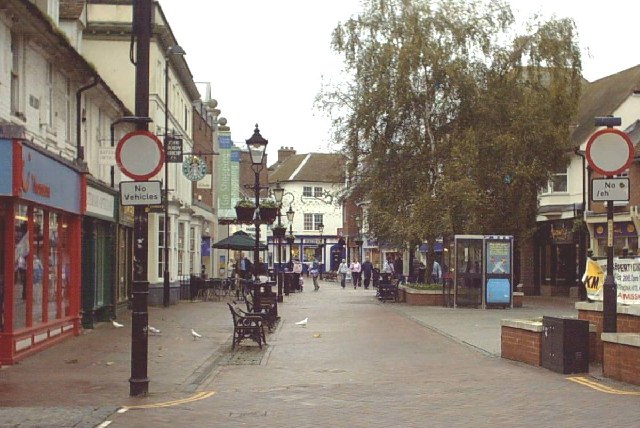
- Adam Colton. Hero image: Ashford Town Centre - Upper High Street - geograph.org.uk - 74845.jpg. Wikimedia Commons · CC BY-SA 2.0.Image source ↗
Related Sanctuary capabilities
From analysis to implementation.
Discussion
No approved comments yet.