
Key findings
- Affordable housing is likely to provide more dependable construction demand than private new build through 2027–29, but this is a relative advantage rather than evidence of an imminent national housebuilding surge.
- The critical measure is conversion: grant allocation must become an identified site, a viable scheme, a procured contract, a start and then a completion. Each stage has distinct delivery risks.
- Weak private housing activity may improve competitive tendering in some areas, but it does not remove cost inflation, supplier fragility, infrastructure dependencies or local skills shortages.
- The strongest opportunities will sit with delivery platforms that can sequence multiple schemes, standardise procurement and make constraints visible early—not simply with organisations holding the largest nominal funding allocations.
- Local economic value will depend on connecting future housing packages to SME supply chains, training capacity and employment pathways before main works begin.
The central judgement: public funding can cushion the cycle, but it cannot manufacture build-ready schemes
**Forecast horizon: late 2026 to March 2029.** England’s housing-construction market is likely to remain divided over the next two years. Private new-build activity is currently weak, while the enlarged Social and Affordable Homes Programme (SAHP) provides a substantial and longer-term source of public demand. That makes affordable housing comparatively important to the construction market. It does not mean that every allocation will translate quickly into homes.
The distinction matters now because policy discussion can too easily equate funding with delivery. Grant can close viability gaps and give providers confidence to plan ahead. It cannot, by itself, resolve land assembly, planning conditions, utility connections, abnormal costs, design and client capacity, procurement timetables, contractor appetite or access to skilled trades. These are not peripheral implementation issues: they determine when expenditure becomes work on site.
The Budget states that the SAHP represents more than £40 billion of capital investment over ten years following a further £1.5 billion announced in October 2026, intended to support around 10,000 additional homes and prioritise Social Rent, particularly council homes (GOV.UK, 2026) ↗. Earlier SAHP allocations gave 33 Strategic Partners £9.58 billion. The government’s accompanying council-housebuilding package also directs significant resource through mayoral strategic authorities and places emphasis on Social Rent delivery (GOV.UK, 2026) ↗. This is meaningful demand support and improves the visibility of the affordable-housing pipeline.
Yet the broader outlook remains constrained. The Office for Budget Responsibility (OBR) expects net additions to the housing stock to decline from around 230,000 in 2025–26 to 220,000 in both 2026–27 and 2027–28, before a gradual recovery. It identifies weaker permissions, higher interest rates, affordability pressures, material costs and regulatory burdens among the factors holding back supply (GOV.UK, 2026) ↗.
**Sanctuary’s assessment is therefore selective acceleration, not a universal boom.** Affordable housing should become a more resilient source of work during 2027–29, especially for established providers, councils and delivery partners with mature sites. National output will remain limited by the pace at which funded ambition is converted into technically and commercially deliverable schemes.
Why the wider market still matters to affordable delivery
The latest construction data reinforce the case for caution. Great Britain construction output fell by 1.0% in the three months to August 2026, while new work fell by 1.4%. Private housing new work was the largest negative contributor, declining by 3.2% over the period (Office for National Statistics, 2026) ↗. Affordable housing will not be insulated from this environment simply because its funding model differs from private sale.
There are two opposing effects. On one hand, softer private demand can create more interest in public-sector frameworks and may improve tender competition. Contractors, consultants and specialist subcontractors may value a visible, multi-year programme when speculative work is scarce. On the other hand, a weak market can expose fragile balance sheets among suppliers, reduce the capacity of smaller firms to carry pre-construction risk and disrupt local subcontractor networks. A lower volume of private activity is therefore not automatically a delivery dividend for social housing.
Cost movements are a more immediate test of whether nominal allocations retain their purchasing power. Construction-material prices for all work were 7.2% higher in September 2026 than a year earlier. The New Housing index increased by 5.4%, while Other New Work rose by 8.5% (BCIS, 2026) ↗. For schemes approved against earlier cost plans, this can reopen viability gaps after grant has been allocated. Providers may respond by redesigning, delaying procurement, reducing scope or concentrating on lower-risk sites. None of those choices necessarily signals poor management; they reflect the trade-off between preserving a programme’s volume, quality and financial resilience.
The medium-term direction is nevertheless more supportive for publicly backed housing than for the construction market as a whole. CITB forecasts a 0.2% fall in UK construction output in 2026, followed by growth of 1.8% in 2027 and 2.8% in 2028. It identifies public new housing as the fastest-growing major construction segment between 2026 and 2030, with average annual growth of 3.6%, ahead of both infrastructure and private new housing at 2.5% (CITB, 2026) ↗. These are sector forecasts rather than delivery commitments, but they provide a plausible basis for expecting affordable housing to outperform the wider market.
The practical implication is that providers should not treat market weakness as a reason to wait passively for lower prices. They should use the period to test schemes against updated costs, secure delivery partners and decide which sites can genuinely move into construction.
The conversion chain is the real delivery system
The SAHP changes delivery through three linked mechanisms. First, grant improves viability where rental income and borrowing capacity cannot meet development costs unaided. Second, a longer programme horizon enables councils and housing associations to manage portfolios rather than assemble isolated annual bids. Third, a credible pipeline can support investment in development teams, supply-chain relationships and repeatable construction approaches.
Each mechanism has a limiting condition. Viability support has limited effect where abnormal costs, infrastructure obligations or unresolved technical risks remain too large. Portfolio certainty only creates starts where organisations have sufficiently mature land pipelines and client-side capability. Suppliers are more likely to invest in people and capacity when allocations become visible packages of work, not when they remain contingent ambitions.
Homes England’s SAHP design recognises this distinction. Its continuous market engagement route places weight on early starts and completions, particularly by 31 March 2029. Strategic Partners are required to convert at least 50% of their allocations into identified sites by 31 March 2031 (GOV.UK, 2026) ↗. The latter milestone is important, but it is not by itself a near-term assurance of delivery. A named site may still require consent, detailed design, utilities coordination, tender approval and a financially acceptable contract.
For that reason, the best management indicators are not aggregate programme totals. They are the proportions of allocated grant attached to: identified sites; consented or otherwise development-ready sites; schemes with settled costs; procurements in market; contracts awarded; starts; and completions. Reporting these stages separately reveals where a pipeline is failing. It also prevents a common error: assuming that a large headline allocation represents immediate revenue for contractors or immediate housing supply for a place.
Planning reform remains material, but it is not a sufficient operating condition for construction. The OBR retains a positive assessment of National Planning Policy Framework reforms while judging that permissions and wider economic conditions point to weaker housing supply than previously forecast (GOV.UK, 2026) ↗. The relevant question for leaders is therefore not only whether a scheme can secure permission, but whether it can proceed through every subsequent commercial and technical gate.
Capacity is local: infrastructure, skills and SMEs will shape the geography of delivery
Affordable-housing delivery will vary materially between places because capability and constraints are spatial. Large sites may depend on the same civils, utilities, electrical, project-management and specialist subcontractor capacity required by transport, energy and other infrastructure projects. The UK Infrastructure Pipeline improves market visibility by bringing together information on expected spend, project status, completion and workforce requirements. It is a useful planning tool, but it does not guarantee that local labour and supply chains can meet simultaneous demand (GOV.UK, 2025) ↗.
CITB estimates that construction will need an average 41,200 additional workers each year between 2026 and 2030 to meet demand and replacement needs. The forecast workforce rises from 2.61 million in 2025 to 2.68 million in 2030 (CITB, 2026) ↗. Aggregate growth, however, is not the same as the availability of the required occupations in the locations where schemes are ready to start. A council with land and grant can still lose time if it cannot access development managers, quantity surveyors, site supervisors, installers or reliable subcontractors.
This has an important local-economic-development dimension. Housing procurement can create opportunities for SMEs, but small firms cannot sustainably respond to vague or fragmented demand. They need early sight of packages, proportionate bidding requirements, prompt payment and a workload sufficiently predictable to justify recruitment and training. Providers that sequence several sites, use repeatable specifications and publish forward procurement plans are more likely to draw in local firms than those that bring a single complex scheme to market at short notice.
The same principle applies to employability. Apprenticeships and local labour clauses are most credible when linked to named packages, employer demand and supervised site experience. A place should map its planned housing pipeline against local colleges, contractors, social enterprises and employment intermediaries before main works commence. This turns procurement from a compliance exercise into a route to local productive capacity.
There is a counterargument: concentrating work among established regional or national contractors can be the quickest way to reduce delivery risk. In some cases that will be justified. The better response is not to impose unrealistic SME quotas, but to design lots, frameworks and pre-construction support so capable smaller firms can participate without absorbing disproportionate commercial risk.
Scenarios to March 2029—and the decisions they imply
**Base case: selective acceleration.** Strategic Partners, larger housing associations and delivery-ready councils progressively convert allocations into starts through 2027 and 2028. Affordable housing outperforms private new build, consistent with CITB’s sector outlook, but national housing additions remain close to the OBR’s subdued near-term profile. Opportunity is concentrated in enabling works, technical design, cost management, procurement, utilities coordination and local labour mobilisation. This is Sanctuary’s central judgement.
**Upside case: delivery platforms scale.** Councils make effective use of the government’s Capacity to Build support, providers commit land pipelines earlier and mayoral areas coordinate multi-site programmes. Procurement is sequenced across portfolios, reducing transaction costs and giving suppliers a credible order book. Improving private-market conditions restore some cross-subsidy, helping mixed-tenure schemes proceed. The catalyst would be observable conversion into named sites, tenders, contracts and starts—not another funding announcement (GOV.UK, 2026) ↗.
**Downside case: funding is absorbed by cost and complexity.** Materials inflation remains elevated, schemes encounter unresolved delivery conditions and client-side capacity cannot keep pace. Providers protect balance sheets by slowing commitments, prioritising lower-risk sites or redirecting activity towards acquisitions. This would leave a substantial programme in place but reduce its construction impact before March 2029. The OBR’s account of weak permissions, interest-rate pressures and regulatory constraints makes this a credible risk rather than a remote tail event (GOV.UK, 2026) ↗.
These are operational scenarios, not probability forecasts. Their purpose is to guide action under uncertainty. Councils and providers should run a delivery control process that identifies the next binding constraint for every scheme—land, planning, design, utilities, governance, finance, procurement or workforce—and assigns an owner and resolution date. They should separate near-term buildable schemes from medium-term land and infrastructure work rather than allowing both to sit in a single undifferentiated pipeline.
For contractors and consultants, the commercial lesson is equally clear. A published allocation is not a contract opportunity. The strongest proposition is a credible contribution to conversion: accurate cost intelligence, pre-construction support, repeatable low-energy design, transparent compliance evidence, dependable delivery and workable local labour plans. By March 2029, success will be measured not by the scale of funding announced, but by the number of viable sites that have become completed homes—and by whether those homes have strengthened local delivery capability along the way.
Research foundation
References
- HM Treasury (2026). Budget 2026. GOV.UK.Source ↗
- Ministry of Housing, Communities and Local Government (2026). The Social and Affordable Homes Programme and the reinvigoration of council housebuilding. GOV.UK.Source ↗
- Office for Budget Responsibility (2026). Economic and fiscal outlook – October 2026. GOV.UK.Source ↗
- Office for National Statistics (2026). GDP monthly estimate, UK: August 2026. Office for National Statistics.Source ↗
- Building Cost Information Service (2026). Latest construction materials prices. BCIS.Source ↗
- Construction Industry Training Board (2026). Construction Workforce Outlook: Labour Market Intelligence Report 2026 to 2030. CITB.Source ↗
- Homes England (2026). Social and Affordable Homes Programme (SAHP) 2026 to 2036. GOV.UK.Source ↗
- National Infrastructure and Service Transformation Authority (2025). UK Infrastructure Pipeline. GOV.UK.Source ↗
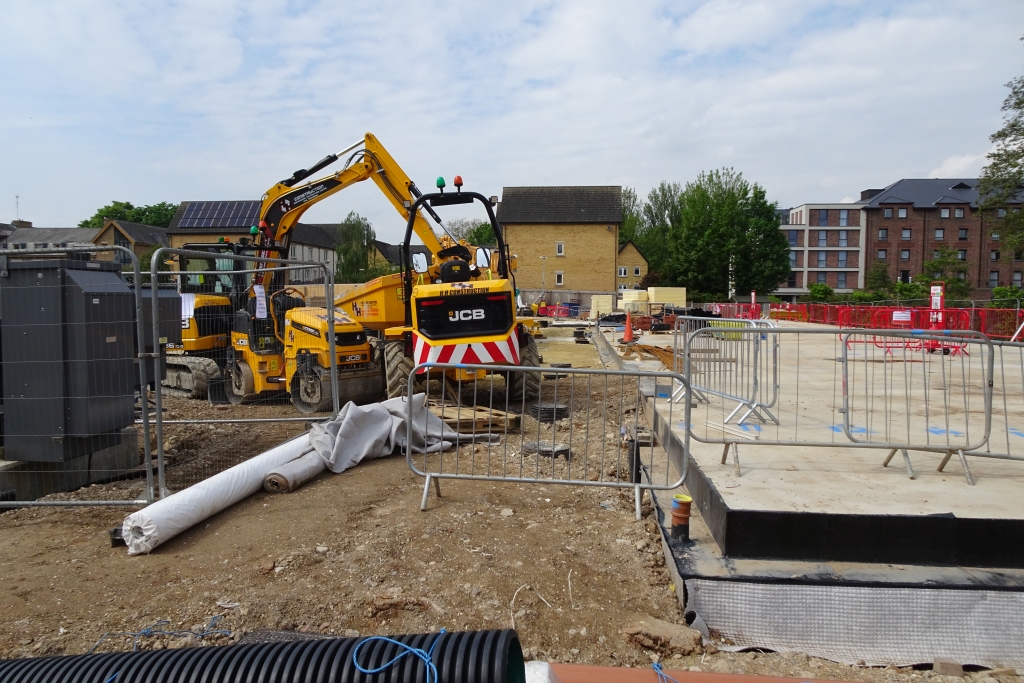
- DS Pugh. Hero image: Construction site on Fishergate - geograph.org.uk - 7769921.jpg. Wikimedia Commons · CC BY-SA 2.0.Image source ↗
Related Sanctuary capabilities
From analysis to implementation.
Discussion
No approved comments yet.