
Key findings
- From 1 April 2026, qualifying retail, hospitality and leisure premises in England with rateable values below £500,000 moved from temporary relief to lower sector-specific multipliers. The reform is material, but its benefit must be assessed at unit level rather than through national headlines.
- Peer-reviewed evidence from earlier UK reliefs indicates that property-tax reductions can lower vacancy among eligible premises. However, the effects are stronger in less deprived areas, where demand and investor confidence are less constrained.
- Recent UK footfall data remain a warning against treating tax reform as proof of high-street recovery: in the four weeks to 31 October 2026, high-street footfall was 5.2% below the previous year.
- The central delivery challenge is conversion: councils, BIDs, landlords and business-support organisations should make rates liabilities clear, target viable voids, reduce leasing friction and strengthen the local demand conditions on which small firms depend.
- The reform applies in England. Leaders elsewhere in the UK should not assume that English multiplier arrangements apply to their local business-rates systems.
The central test is conversion, not the announcement
England’s business-rates reform matters because it changes a recurrent fixed cost for a large part of the physical economy. From April 2026, qualifying retail, hospitality and leisure (RHL) premises below £500,000 rateable value (RV) receive sector-specific multipliers set below the equivalent national multipliers. The arrangement replaces the temporary and capped RHL relief available in 2025–26 with a standing mechanism, intended to give eligible occupiers more certainty over a major overhead (HM Treasury, 2025) ↗.
That is a meaningful improvement on annual relief cycles. For a small retailer, café, gym or venue, greater certainty can improve cash-flow planning, make a lease proposition easier to appraise and leave more management attention for staffing, stock, marketing and customer service. Those are potentially important gains for local enterprise and employment.
But lower rates do not themselves create a viable high street. They do not resolve weak catchment spending, poor access, an unsuitable unit, unaffordable fit-out, antisocial behaviour or a lease that places too much risk on a young business. Nor do they guarantee that the financial benefit remains with the operator rather than being reflected in higher rents or reduced incentives at the next lease event.
The distinction is urgent. In the four weeks to 31 October 2026, UK high-street footfall was 5.2% lower than a year earlier, with weather identified as an important factor in the period (British Retail Consortium, 2026) ↗. This is not evidence that the rates reform has failed: a single, weather-affected monthly comparison cannot establish a structural trend or a policy effect. It is, however, a useful discipline against equating fiscal support with commercial recovery.
**Sanctuary interpretation:** the reform shifts the viability frontier for some premises; it does not determine whether a business crosses it. The strategic task is to make the lower bill visible and usable in a prospective occupier’s business model, while improving the local conditions that generate repeat demand.
Why a lower multiplier does not automatically mean a lower bill
Business-rates discussions often collapse several moving parts into one headline. That is risky in a revaluation year. For 2026–27, the published small-business RHL multiplier is 38.2p for qualifying properties below £51,000 RV, and the standard RHL multiplier is 43.0p for qualifying properties from £51,000 to £499,999 RV. The equivalent national multipliers for non-RHL properties are 43.2p and 48.0p. Properties at £500,000 RV and above fall within the 50.8p high-value multiplier (HM Treasury, 2025) ↗.
In simplified terms, rates liability begins with the property’s RV multiplied by the applicable multiplier, before reliefs, transitional arrangements and other adjustments are taken into account. The multiplier reform and the 2026 revaluation are separate changes. The new rating list reflects estimated open-market rental values at 1 April 2024; the final bill depends on the revised RV as well as the applicable multiplier and any relevant support (Valuation Office Agency, 2026) ↗.
A qualifying occupier can therefore face a lower multiplier but still see a higher bill if its RV has increased sufficiently. Equally, an increase in RV may be more than offset by the multiplier change. The practical implication is straightforward: advice such as ‘rates have fallen for hospitality’ is too blunt to support an investment or leasing decision.
Councils, landlords and BIDs should instead make a unit-level calculation routine. For priority occupied or vacant premises, the relevant question is: **what is the likely annual liability for this address, under this proposed use, after the applicable arrangements are considered?** That calculation should sit beside rent, service charge, lease length, repair obligations, fit-out costs and realistic sales assumptions. It is particularly important for entrepreneurs deciding between a town-centre unit, a retail-park location, home delivery or no physical premises at all.
The policy is England-specific. Business rates are devolved, so commentary framed as a UK-wide high-street intervention should not obscure materially different arrangements in Scotland, Wales and Northern Ireland (HM Treasury, 2025) ↗.
What the evidence says — and what it cannot yet say about 2026
The strongest direct evidence supports the underlying mechanism, with important qualifications. Lockwood, Simmler and Tam use UK data and quasi-experimental variation around eligibility thresholds for small-business and retail-rate reliefs. They find that both reliefs reduce vacancy among eligible properties, and that retail relief produces a larger vacancy reduction per pound of relief than small-business relief (Lockwood, Simmler and Tam, 2026) ↗.
This is consequential. It suggests that property taxation can affect the margin between a premise remaining vacant and returning to occupation. It also challenges the view that high-street vacancy is simply an inevitable consequence of online retail. For local leaders, the relevant mechanism is not abstract: lower recurring occupation costs can improve projected cash flow, reduce the sales required to break even and make a previously marginal business plan fundable.
Yet this is evidence for a mechanism, not a forecast of the 2026 reform’s eventual impact. The study evaluates earlier relief arrangements and uses threshold-based variation. The new multipliers differ in design, economic context and duration. It would be a methodological error to lift an estimated effect from the earlier schemes and present it as a precise prediction for every English town centre.
The distributional finding is equally important. The same research finds that both reliefs are more effective at reducing retail vacancy in less deprived areas (Lockwood, Simmler and Tam, 2026) ↗. This does not make relief futile in more disadvantaged places. It indicates that a tax saving works through an existing market, and that markets with lower disposable income, weaker investor confidence or difficult public-realm conditions may need additional support before that saving becomes sustained occupation.
The UK Parliament’s POST synthesis reinforces both cautions. It identifies positive occupancy effects in the available evidence, while noting the need for further work on outcomes including employment growth. It also highlights the possibility that landlords can capture part of the benefit over time through rents (UK Parliament POST, 2026) ↗.
**Counterargument:** permanence may have effects that temporary relief could not. A standing lower multiplier can reduce policy uncertainty and encourage multi-year investment. That is credible. But certainty is most valuable when an operator also has confidence in demand, lease security and the wider trading environment. It cannot substitute for them.
The £500,000 threshold makes commercial composition a place-level issue
The reform is deliberately targeted. HM Treasury expects more than 750,000 properties to benefit from the RHL multipliers, while just over 21,000 hereditaments fall within the high-value multiplier. Additional receipts from higher-value properties, including an estimated 1,900 distribution warehouses, are intended to help fund the lower RHL multipliers over 2026–27 to 2028–29 (HM Treasury, 2025) ↗.
For many independent businesses below the threshold, this design should improve relative viability. But a high street is an ecosystem rather than a collection of isolated shopfronts. Larger stores, hotels, leisure venues and anchor spaces can generate linked trips, employment and evening activity, yet some may be above the threshold, outside the qualifying definition or poorly matched to the current market.
This does not justify blanket support for every large occupier. It does mean that a place strategy should test the role of larger premises before celebrating aggregate savings among smaller frontages. Where a larger unit genuinely drives linked spending or supports a cluster, its future matters to surrounding SMEs. Where it no longer has a credible market role, subdivision, mixed use, public-service occupation or other adaptation may produce more resilient local value.
This is consistent with the Government’s high-street typology work. It distinguishes major shopping and tourism destinations from office hubs and everyday high streets, and identifies different constraints: office-focused places can face uneven weekday demand, while deprived everyday high streets may combine low catchment income, high vacancy and environmental challenges (MHCLG, 2026) ↗. A uniform tax narrative cannot substitute for a commercial plan calibrated to the function of a particular centre.
A conversion system for turning lower bills into local economic value
The useful unit of delivery is the address, the lease and the prospective operator — not a town-centre average. Sanctuary recommends a four-part conversion system.
**1. Establish a rates-and-viability register.** Map occupied and vacant ground-floor premises by RV band, likely RHL eligibility, current or indicative liability, lease event date, condition, ownership, use and relationship to footfall generators. This need not be a public database of sensitive commercial information. Its purpose is to identify priority units, avoid generic outreach and give business-support teams a shared view of constraints.
**2. Produce a vacancy-to-opening proposition.** For priority units, prospective occupiers should be able to obtain a clear cost pack: indicative rates liability, rent expectation, service charge, condition, fit-out requirements, permissions pathway and a named contact. The proposition should also identify where short licences, test trading, pop-ups, fit-out advice or business-plan support can reduce the risk of a first commitment. A lower annual rate bill has little value if an entrepreneur cannot establish the total cost, timescale and risk of opening.
**3. Pair tax advantage with demand-side delivery.** In fragile centres, fiscal support should be joined to measures affecting how customers experience a place: cleanliness, lighting, safety, wayfinding, access by bus and active travel, events and public-service anchors. Government guidance for everyday high streets similarly points to partnership working, markets, public-service footfall, reuse of larger voids, safety and public-realm measures alongside business support (MHCLG, 2026) ↗. The aim is not simply cosmetic improvement. It is to increase the probability that a viable local business acquires repeat custom.
**4. Monitor who captures the benefit.** Track eligible units contacted, bills checked, priority voids marketed with a cost pack, new occupations, lease incentives, vacancy duration and business survival at six, 12 and 24 months. Add local employment and repeat-footfall measures where data permit. This makes it possible to distinguish a saving that supported investment and management capability from one absorbed by rent, service charges or persistent weak demand.
The trade-off is capacity. Property-level brokerage takes more effort than announcing a town-wide initiative. But it is also the level at which a prospective employer or entrepreneur decides whether to open, expand or walk away.
How to judge the reform through spring 2027
The first credible assessment should not rest on a national announcement or a raw change in local vacancy. Revaluation effects, wider consumer conditions, weather, landlord behaviour and local regeneration activity will all shape outcomes. Evaluation should therefore combine property data with meaningful comparators.
First, examine **occupation at the margin**: are formerly marginal qualifying RHL units below £500,000 RV returning to use more quickly than comparable non-RHL or non-eligible units? Second, test **benefit capture**: are asking rents, rent-free periods or service charges changing in ways that reduce the occupier’s gain? Third, assess **business durability**: do new occupiers survive beyond their first seasonal cycle and retain or create local jobs? Finally, measure **linked demand**: are interventions increasing visits and cross-spend, rather than merely moving activity between nearby streets?
An encouraging pattern would be lower vacancy in eligible units, stable lease terms, durable openings and improving repeat footfall. A weaker pattern would be limited occupation gains alongside rising occupancy costs or continued falls in discretionary visits. Neither outcome should be over-interpreted in isolation. The former would not prove that rates reform alone revived a centre; the latter would not show that the policy was worthless. It would indicate where demand, property quality or local delivery is constraining the mechanism identified in the evidence.
**Sanctuary perspective:** England has created a more stable rates instrument for a substantial share of high-street premises. Its value will be determined locally. The places best placed to benefit will combine bill-level clarity with active property brokerage, capable support for entrepreneurs and credible reasons for residents and visitors to return regularly.
Research foundation
References
- HM Treasury (2025). Effects of the business rates retail, hospitality and leisure multipliers and high-value multiplier. GOV.UK.Source ↗
- Valuation Office Agency (2026). Business rates: Revaluation. GOV.UK.Source ↗
- Ben Lockwood; Martin Simmler; Eddy H. F. Tam (2026). Tax and Occupancy of Business Properties: Evidence from UK Business Rate Reliefs. American Economic Journal: Economic Policy, 18(3), 372–410.Source ↗DOI: 10.1257/pol.20240302
- Parliamentary Office of Science and Technology (2026). Impacts of taxation on small businesses: Business rates in the UK. UK Parliament POST.Source ↗
- British Retail Consortium and Sensormatic Solutions (2026). Stormy weather washes away footfall. British Retail Consortium.Source ↗
- Ministry of Housing, Communities and Local Government (2026). Hope on the High Street. GOV.UK.Source ↗
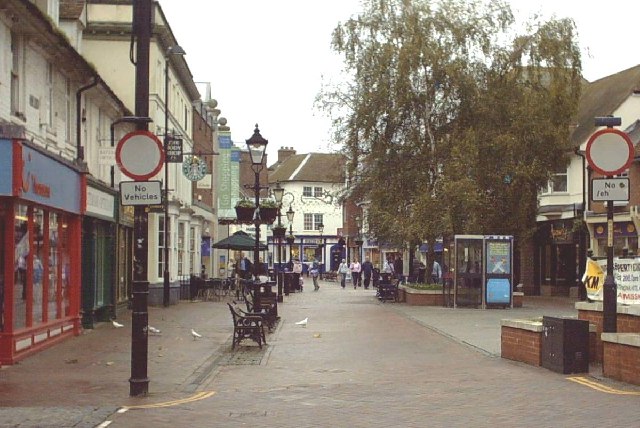
- Adam Colton. Hero image: Ashford Town Centre - Upper High Street - geograph.org.uk - 74845.jpg. Wikimedia Commons · CC BY-SA 2.0.Image source ↗
Related Sanctuary capabilities
From analysis to implementation.
Discussion
No approved comments yet.