
Key findings
- Pride in Place offers rare scope for patient local investment, but the 2026 planning timetable may still favour visible capital schemes before Boards have resolved who will operate, maintain and use them. [[mhclg-pip-prospectus-2026]] [[mhclg-pip-delivery-2026]]
- The Towns Fund evaluation supports qualified confidence in targeted town-centre intervention: Future High Streets Fund places saw relative footfall improvement, but this is not evidence that footfall alone creates resilient firms, productivity or locally retained value. [[mhclg-towns-fund-2026]]
- The binding constraint on a high street is often not simply appearance or vacancy. It may be a combination of poor premises, restrictive leases, weak occupier pipelines, unaffordable fit-out, inadequate management capacity and unreliable day-to-day stewardship. [[peel-parker-2017]] [[mhclg-hsra-guidance-2025]]
- Boards should use early, reversible activity to test assumptions and remove immediate barriers, while requiring a higher standard of evidence for capital commitments that create long-term operating, maintenance and disruption risks.
Pride in Place should build an operating centre, not a longer project list
Pride in Place matters because it gives English places something regeneration policy rarely supplies at the same time: meaningful capital, a ten-year horizon and an expectation of community participation. The programme covers 284 communities, with up to £20 million of funding and support per place. Yet its design also creates a near-term pressure: Phase 2 Boards must submit plans by 30 November 2026, while local authorities initially act as accountable bodies and the programme anticipates a move towards community-led delivery by the end of year three. ↗ ↗
That combination of long-term funding and an early plan deadline presents a practical risk. Projects with clear drawings, cost plans and political visibility can move ahead before a Board has tested whether the asset will be used, by whom, and at what continuing cost. A refurbished building, upgraded square, shopfront grant or events programme may each be justified. But none is an operating model.
The distinction is consequential for local economic value. Capital works create value only through the system around them. A renewed unit needs an occupier with a credible offer, a workable lease, affordable fit-out and sufficient working capital. A redesigned public space needs cleaning, maintenance, safety management and reasons for people to return outside launch events. Construction needs disruption management so that existing traders are not asked to absorb the cost of improvement through lost custom. Boards need enough information and authority to change course when their original assumptions fail.
This is not an argument for delaying physical investment until every uncertainty is resolved. Unsafe routes, poor accessibility, neglected public realm and unusable buildings can be genuine constraints on trade, employment and everyday access to services. The analytical question is narrower and more useful: which constraint does a proposed investment remove, and what must happen alongside it for productive activity to follow?
**Sanctuary recommendation:** Boards should describe each priority as an investment proposition, not merely a project. It should state the constraint being addressed; the mechanism through which change is expected; the delivery owner and dependencies; the operating and maintenance requirement; the intended beneficiaries; and the evidence that would justify adaptation, expansion or closure. This does not make plans bureaucratic. It makes their causal logic testable.
The evidence supports targeted intervention—but not an automatic regeneration effect
The final Towns Fund evaluation provides a stronger basis for judgement than the familiar claim that regeneration either always works or never does. Using quasi-experimental analysis alongside case studies, process evidence and value-for-money work, it found that Future High Streets Fund towns recorded a 6.7% relative increase in footfall compared with similar non-funded towns. By the third quarter of 2025, funded towns had recovered to 97.9% of equivalent 2019 footfall, against 91.3% in comparator towns. ↗
That is material evidence that focused town-centre intervention can influence activity. It is not evidence that every capital scheme produces business resilience, higher productivity or enduring local wealth. Some schemes were too recent for longer-run effects to be observed. Evidence on business creation was mixed and, in some cases, sensitive to modelling choices. The evaluation also identified short-term relative reductions in business counts in Future High Streets Fund areas, plausibly linked in part to delivery and construction disruption. ↗
The policy implication is not to abandon capital; it is to use diagnosis before design. Investment has a strong case where it removes an evidenced barrier: an unsafe pedestrian connection, an inaccessible building, a derelict unit whose condition prevents occupation, or infrastructure that blocks an otherwise viable use. Its case is weaker where the binding issue is unaffordable fit-out, unsuitable lease terms, fragmented ownership, limited management capability or insufficient customer demand. A better façade cannot repair an unworkable business model. Equally, an entrepreneur with a credible offer cannot always overcome premises that are physically or contractually unusable.
This matters particularly for SMEs and prospective entrepreneurs. Independent firms can bring local knowledge, distinctive products and adaptable service offers, but may lack the reserves to bridge high fit-out costs, an extended vacancy process or disruption during works. Conversely, resolving one property, access or permissions constraint can unlock private effort that generic promotion will not. The meaningful test for public investment is therefore not simply what asset it delivers, but whether it lowers the cost and risk of productive activity for viable operators.
Peel and Parker’s analysis remains useful here. They frame high-street restructuring as a planning and governance challenge as well as a retail challenge, shaped by relationships and coordination failures between local actors. ↗ For Pride in Place, the relevant unit of analysis is not a single shop or square but the local operating system: property, occupiers, public realm, services and governance working together—or failing to do so.
Footfall is a signal of use, not a definition of local economic value
Footfall should be treated as useful intelligence rather than the headline definition of renewal. The Office for National Statistics reported that UK retail footfall was 6% lower in September 2026 than in August and 1% lower than in September 2025. Town and city centres were down 8% month on month, while town/city and district/local centres were broadly unchanged year on year. These are timely, non-seasonally adjusted indicators: they can reveal changing conditions, but cannot establish a structural monthly decline or judge the performance of an individual town. ↗
For Boards, footfall can help test whether a route, event or public-realm intervention changes how people move through a centre. It cannot independently show whether local firms are surviving, residents can access essential services and employment, entrepreneurs are developing management capability, or value is being retained locally. A centre organised around everyday services, health, learning, civic activity, food, culture and independent enterprise has a different economic logic from one reliant on comparison-shopping trips.
The same caution applies to vacancy. An empty unit may signal weak demand, but it may also reflect disrepair, impractical layouts, fit-out costs, lack of servicing, inaccessible lease terms or an owner unwilling to transact. Treating vacancy as a single problem leads to blunt responses. Understanding why a particular unit is empty creates the possibility of targeted property action.
A credible Board dashboard should therefore cover four domains: place condition, including cleanliness, accessibility and perceived safety; use, including pedestrian activity and participation; economic capability, including occupancy quality, business openings and survival; and distribution, including who can access, work in, trade in and influence the centre. No single measure settles the question. Together, the measures can reveal whether the constraint is demand, property, access, management or business readiness.
Business-rates policy illustrates this distinction. Budget 2025 set out lower retail, hospitality and leisure multipliers for eligible English properties with rateable values below £500,000. ↗ Lower fixed costs may help an otherwise viable business at the margin. They do not create demand, finance fit-out, remedy disrepair or align a landlord with a prospective occupier. Local delivery still needs an enterprise pipeline and a practical route from initial interest to sustainable occupation.
Connect occupier development, property intelligence and stewardship
The first delivery question is the realistic role of the centre. “Revitalisation” is an ambition, not an operating proposition. Boards should assess which functions are plausible given local demand, catchment, transport links and existing assets: everyday services, market trading, food and culture, workspace, health, learning, civic activity or visitor uses. A centre may support several functions, but the mix should follow local conditions rather than reproduce another town’s formula.
Second, Boards should develop occupiers rather than simply seek to fill units. A live pipeline can include existing traders, market operators, home-based businesses, social enterprises, creative practitioners and community anchors. Support with cash flow, lease obligations, pricing, staffing, compliance, customer acquisition and premises management can reduce avoidable failure. Such support cannot manufacture demand. It can, however, help capable operators cross the difficult gap between an idea, a short-term trial and a viable trading presence.
Third, property action requires unit-level intelligence. For priority premises, Boards should understand condition, ownership, lease constraints, accessibility, repair needs, service capacity and likely fit-out costs. High Street Rental Auctions may be appropriate where statutory eligibility and local-benefit tests are met. However, the non-statutory guidance indicates that the formal process can take around 22 to 24 weeks from initiation to completion. ↗ A Board should therefore identify and prepare viable occupiers in parallel. An auction can address persistent vacancy; it cannot make an unviable business viable.
Fourth, stewardship is economic infrastructure. Cleaning, maintenance, wayfinding, safety reporting, coordinated information and regular communication with traders affect whether customers, staff and entrepreneurs experience a centre as dependable. These functions require named responsibility, an operating budget and service standards. Dispersing them across short-lived projects risks creating a place that looks improved but remains difficult to use or manage.
Finally, governance must support operational decisions rather than merely approve expenditure. Pride in Place delivery guidance requires transparent arrangements for decisions, minutes, conflicts of interest and spending, and allows investment in secretariat capacity. ↗ Community-led delivery can improve legitimacy and local intelligence. But it should not transfer complex responsibilities to volunteers without sufficient support, authority or administrative capability.
Stage commitments: learn early, then invest with conviction
The appropriate response to uncertainty is not inertia. It is to distinguish between actions that are reversible and commitments that are expensive to unwind. Early activity can include consistent pedestrian and vacancy monitoring, clearer wayfinding, trials of market formats, targeted support for prospective occupiers, and resolution of a small number of high-value property barriers. These measures can create visible progress while testing the assumptions on which larger investments depend.
Pilots, however, must not become an excuse for avoiding decisions. Each should have a named owner, timeframe, decision rule and route into mainstream delivery if the results justify continuation. Major capital schemes should face a higher threshold. Before committing, Boards should be able to show credible arrangements for ownership, permissions, maintenance, operating revenue, user demand and disruption mitigation.
There is a genuine trade-off. More evidence before major commitments can delay visible change, and communities reasonably expect progress after years of stalled plans. Yet rapid delivery that disrupts viable firms, creates unfunded maintenance liabilities or produces underused assets is not a more equitable form of action. The Towns Fund evaluation points to both sides of this argument: disruption can weaken business activity in the short term, while durable effects may not be observable until schemes are complete and embedded. ↗
**Sanctuary recommendation:** apply five tests to every significant high-street commitment. **Additionality:** what changes because of this investment? **Operator reality:** who will use, manage and maintain it? **Sequencing:** what must happen first? **Distribution:** who benefits and who may be excluded? **Learning:** what finding would trigger adaptation, pause, expansion or closure? Boards should publish disruption-mitigation plans and review milestones, then be willing to reallocate resources within an agreed strategy when the evidence warrants it.
The ultimate test of Pride in Place is not whether works are delivered on schedule. It is whether a centre becomes easier to use, trade in, manage and adapt after the initial works are complete. The strongest plans will link capital to an occupier pipeline, informed property action, dependable stewardship and accountable governance. That is how a ten-year programme can support a more adaptable local economy rather than simply fund a longer list of projects.
Research foundation
References
- Ministry of Housing, Communities and Local Government (2026). Pride in Place Programme: prospectus. GOV.UK.Source ↗
- Ministry of Housing, Communities and Local Government (2026). Pride in Place Programme: delivery guidance. GOV.UK.Source ↗
- Ministry of Housing, Communities and Local Government (2026). Towns Fund evaluation: final findings. GOV.UK.Source ↗
- Office for National Statistics (2026). Economic activity and social change in the UK, real-time indicators: 22 October 2026. Office for National Statistics statistical bulletin.Source ↗
- HM Treasury (2025). Budget 2025. GOV.UK.Source ↗
- Ministry of Housing, Communities and Local Government (2025). High Street Rental Auctions: non-statutory guidance. GOV.UK.Source ↗
- Deborah Peel and Cathy Parker (2017). Planning and governance issues in the restructuring of the high street. Journal of Place Management and Development, 10(4), 404-418.Source ↗DOI: 10.1108/JPMD-01-2017-0008
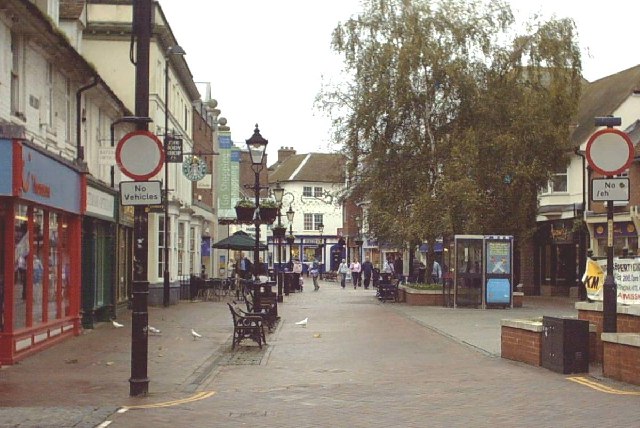
- Adam Colton. Hero image: Ashford Town Centre - Upper High Street - geograph.org.uk - 74845.jpg. Wikimedia Commons · CC BY-SA 2.0.Image source ↗
Related Sanctuary capabilities
From analysis to implementation.
Discussion
No approved comments yet.