
Key findings
- UK business births rose to 326,000 in 2025, while business deaths fell to 271,000. This is a positive signal of entrepreneurial entry, but it is not evidence on its own that more firms have secured durable demand, sound margins or sustainable jobs. (Office for National Statistics, 2026) [[ons2026]]
- Only 37.6% of businesses born in 2020 were still active in 2025. The five-year figure reinforces the need to treat post-launch execution—not registration—as the central challenge for many founders. (Office for National Statistics, 2026) [[ons2026]]
- Employment-defined high-growth businesses accounted for 4.7% of UK businesses with at least 10 employees in 2025. Formation, survival and employer growth are distinct stages requiring different forms of support. (Office for National Statistics, 2026) [[ons2026]]
- Equity finance remains material but has become more selective: seed-stage deal numbers fell in 2025 while growth-stage investment increased. For many smaller firms, the immediate issue is not access to venture capital but matching finance to cash flow, assets and customer-payment terms. (British Business Bank, 2026a; British Business Bank, 2026b) [
Business formation is improving—but it is not the same as economic conversion
The UK should welcome the latest business-demography figures without mistaking them for a verdict on the quality of the start-up economy. There were 326,000 business births in 2025, up from 317,000 in 2024, while deaths fell from 283,000 to 271,000. The birth rate rose to 11.3% and the death rate fell to 9.4%. On the face of it, this is an encouraging improvement in enterprise activity. (Office for National Statistics, 2026) ↗
**Interpretation.** The strategically important question now is what happens after entry. A new business can represent a credible commercial proposition, a route into self-employment, a response to local demand, or a necessary attempt to replace lost income. Those routes matter, but they do not have identical prospects or policy needs. Counting them together is useful for understanding business formation; it is insufficient for judging whether a local economy is generating resilient firms, better jobs or productivity gains.
That distinction matters particularly for the UK now. Many high streets and local economies need more than visible entrepreneurial activity. They need businesses that can retain customers, pay suppliers and staff reliably, withstand a weak month, and—where the model warrants it—become capable employers. The policy and practice challenge is therefore conversion: turning early trading activity into an operating model that is commercially repeatable.
This is not an argument that every founder should pursue rapid scale. A viable owner-managed business, specialist practice or community enterprise can create real economic and social value without becoming a 20-person company. The error is to make registration the endpoint, or to judge every venture by a single growth template. Better enterprise support differentiates between sustainable small business, local employer, specialist firm and equity-backed growth company, then helps each pursue an appropriate route.
Use business-birth data for what it measures—and recognise what it cannot tell us
**Evidence.** ONS business births are not Companies House incorporations. They are new registrations identified through VAT and/or PAYE administrative records, while an active business is one with turnover or employment in the reference year. This makes the measure a more meaningful indicator of trading and employment activity than a simple count of legal entities. It also means that businesses without VAT or PAYE registration are outside the core measure. (Office for National Statistics, 2026) ↗
**Methodological caution.** This is an important strength, but it sets clear limits on interpretation. The data do not establish why a business started or ceased, whether it has product-market fit, the quality of employment it creates, or the profitability of its model. Nor should a national birth rate be treated as evidence that every place, demographic group or sector is benefiting equally. Aggregate demography identifies patterns that deserve attention; it does not, by itself, diagnose causes.
**Sanctuary interpretation.** The most useful response is to add operational measures that capture the transition from formation to resilience. For individual firms, these include recurring or repeatable revenue, gross margin, customer concentration, cash conversion, timely tax compliance and the extent to which delivery depends on the founder alone. For enterprise programmes, 12- and 24-month trading continuity should sit alongside starts. This does not devalue start-up numbers. It places them at the beginning of a more demanding and more useful account of economic progress.
A registration-led target can create an unintended incentive: support providers may be rewarded for helping people cross the threshold into business without having the capacity to support the more difficult work of pricing, selling, managing cash and redesigning delivery. A conversion-led approach asks which businesses have credible demand and what is blocking their next stage of development.
Sector churn shows why volume is a weak proxy for entrepreneurial value
**Evidence.** Entry and exit rates vary sharply across sectors. Transport and storage had the highest business birth rate in 2025, at 17.0%, but also the highest death rate, at 14.3%. Accommodation and food services recorded a 15.1% birth rate and a 12.7% death rate. Property had the lowest death rate, at 6.3%. (Office for National Statistics, 2026) ↗
These figures do not show that founders in higher-churn sectors are less capable, or prove why firms close. They do, however, show why a high number of starts should not be read automatically as a sign of deepening local economic capacity. Business models with low barriers to entry may also face intense competition, volatile demand, narrow margins, platform dependency or high working-capital pressure.
**Interpretation.** In a café, delivery, retail or personal-service business, the decisive management choices may be less glamorous than the launch itself: whether pricing covers labour and overheads; whether opening hours match demand; whether supplier and customer terms create a cash squeeze; and whether the offer is sufficiently differentiated to avoid competing only on price. In such circumstances, “start quickly” can be inferior advice to “test cheaply, price honestly and protect cash”.
**Sanctuary recommendation.** Place-based support should segment firms early by operating reality rather than treating all founders as future scale-ups. A provisional pathway discussion can distinguish a stable owner-managed business, a local employer, a specialist professional firm, a technology-enabled growth business and a social or community enterprise. This is not a judgement about ambition. It is a practical way to align the support offered—pricing, management capability, workforce planning, procurement, innovation records or investment readiness—with the venture’s economics.
The missing middle is the move from founder-led trading to a managed firm
**Evidence.** The five-year survival rate for businesses born in 2020 was 37.6%. Separately, the ONS counted 13,940 employment-defined high-growth businesses in 2025, down from 14,330 in 2024. They represented 4.7% of the 298,395 businesses with at least 10 employees. The high-growth measure covers firms with at least 10 employees that achieved average employment growth of more than 20% a year between 2022 and 2025. (Office for National Statistics, 2026) ↗
The survival cohort and the high-growth measure should not be mechanically combined: they cover different populations and high growth is not the only legitimate definition of success. Yet together they expose a meaningful gap between starting a business and building an established employer. That gap is where local economic value can either compound—through jobs, supplier spend and management capability—or dissipate through avoidable business failure.
**Interpretation.** The move beyond founder-only delivery is a qualitative change, not simply a larger version of launch. A founder’s knowledge has to become a documented process; sales must become a pipeline rather than a personal effort; payroll, tax and customer-payment timing have to be managed together; and the first hire must remove a genuine constraint. Without these systems, growth can worsen cash pressure and reduce service quality. With too much process too early, a small firm can become slow and overburdened. The task is to build a minimum viable operating system, not a corporate bureaucracy.
**Sanctuary recommendation.** Firms approaching a first substantive hire should create a 12-month conversion plan covering five questions: who is the priority customer; what level of contribution margin is required; where is the monthly cash trough; what sales activity produces dependable demand; and which role will release the founder from the most binding constraint? This is practical management capability work. It is also a productivity intervention, because it makes outcomes less dependent on individual stamina and improvisation.
Finance is available, but fit matters more than founder narratives
**Evidence.** UK smaller businesses raised £12.3 billion in equity investment across 2,002 deals in 2025. Investment value fell by 4% and deal numbers by 17% from the previous year; the ten largest fundraisings represented 23% of total investment. Seed-stage deal numbers fell by 27%, while growth-stage investment rose 10% to £5.7 billion. (British Business Bank, 2026a) ↗
The British Business Bank also reports that around half of smaller businesses seek external finance, with greater use of flexible finance in 2025 to support cash flow. It notes that equity remains important for scale-up firms, while equity use declined in 2025 to around its 2019 level. (British Business Bank, 2026b) ↗
**Interpretation.** The evidence complicates the familiar claim that start-ups simply face a universal funding gap. Equity is relevant to a minority of businesses with a model capable of supporting high growth and investor returns, and the 2025 market appears more concentrated and selective at early stage. For many SMEs, the pressing question is finance fit: whether the form and timing of finance match the way cash enters and leaves the business.
A firm with reliable invoices may need working-capital support; an asset-intensive company may need asset finance; a knowledge-intensive venture with a long development cycle may be better suited to equity, grant support or a combination; and a service business may be better served by slower, customer-funded growth. Each route carries trade-offs. Debt can create repayment pressure before revenues are secure; equity can dilute control and raise expectations for growth; customer funding can preserve ownership but constrain the pace of investment.
**Sanctuary recommendation.** Founders should prepare a financing map before approaching a lender or investor. It should identify the monthly cash trough, the use of funds, customer-payment assumptions, the downside case and the conditions under which a particular instrument becomes unsuitable. This is not simply a pitch document. It is a decision tool that can prevent a viable business from accepting capital that intensifies, rather than resolves, its risk.
Administrative simplification can help—but it cannot replace commercial readiness
**Evidence.** The government has announced that the R&D tax-relief Claim Notification Form will be removed for claims made on or after 1 April 2027. HMRC also plans to simplify and rationalise the Additional Information Form from autumn 2027. (HM Treasury, 2026) ↗
**Interpretation.** This should reduce friction for eligible companies, including first-time claimants affected by advance-notification requirements. It is a useful improvement in the support environment, but it should not be overinterpreted. Tax-relief process changes do not create customer demand, establish a viable price, correct a weak cost base or make a company investable. The benefit depends on a firm undertaking qualifying activity and maintaining credible records.
The wider lesson is that public support works best when it meets a business that is operationally ready to use it. Innovation-led SMEs need more than awareness of reliefs or funding schemes; they need clear project records, commercial priorities, cash discipline and governance sufficient to make timely decisions. Administrative simplicity is valuable precisely because founders have limited management bandwidth. It cannot, however, substitute for the underlying commercial work.
For local enterprise systems, this argues for combining signposting with capability building. A founder who understands the mechanics of a scheme but lacks a viable customer proposition is unlikely to gain much from it. A founder with sound customer evidence and a disciplined operating model is far more likely to turn support into productive investment.
A better scorecard for founders, advisers and place leaders
The rise in business births is good news. The risk is that the public conversation stops there. If the aim is stronger SMEs, more resilient high streets and local economic value that lasts, the scorecard must follow firms beyond launch.
**For founders.** Replace a registration-led plan with a conversion-led plan. Track one measure each for demand quality, margin, cash, delivery capacity and founder dependency. Ask whether the business can maintain its price without routine discounting, whether a late-paying customer would cause distress, and whether a first hire would unlock capacity rather than simply add overhead.
**For advisers and ecosystem partners.** Segment support by business pathway and sector conditions. Higher-churn businesses may need hands-on work on pricing, scheduling and cash. Knowledge-intensive companies may need stronger records and finance readiness. Potential local employers need workforce planning before recruitment becomes urgent. A standard workshop sequence is unlikely to address all three needs well.
**For place leaders.** Measure starts alongside survival, progression into employment, local procurement, finance progression and, where feasible, productivity signals. National ONS data provide a valuable benchmark, but local interventions should be assessed with local cohort data and a clear account of what counts as success for different types of venture.
**Sanctuary judgement.** The UK does not need to choose between encouraging enterprise and demanding better outcomes from it. It needs to connect the two. The more difficult work begins after launch: validating demand, protecting cash, building management routines and choosing finance that fits the model. That is where entrepreneurial energy becomes a durable business base rather than a short-lived statistical gain. (Office for National Statistics, 2026; British Business Bank, 2026a; British Business Bank, 2026b) ↗ ↗ ↗
Research foundation
References
- Office for National Statistics (2026). Business demography, UK: 2025. Office for National Statistics.Source ↗
- British Business Bank (2026). Small Business Equity Tracker 2026. British Business Bank.Source ↗
- British Business Bank (2026). Small Business Finance Markets Report 2026. British Business Bank.Source ↗
- HM Revenue & Customs (2026). Research and Development (R&D) Tax Reliefs: improving the customer experience. GOV.UK.Source ↗
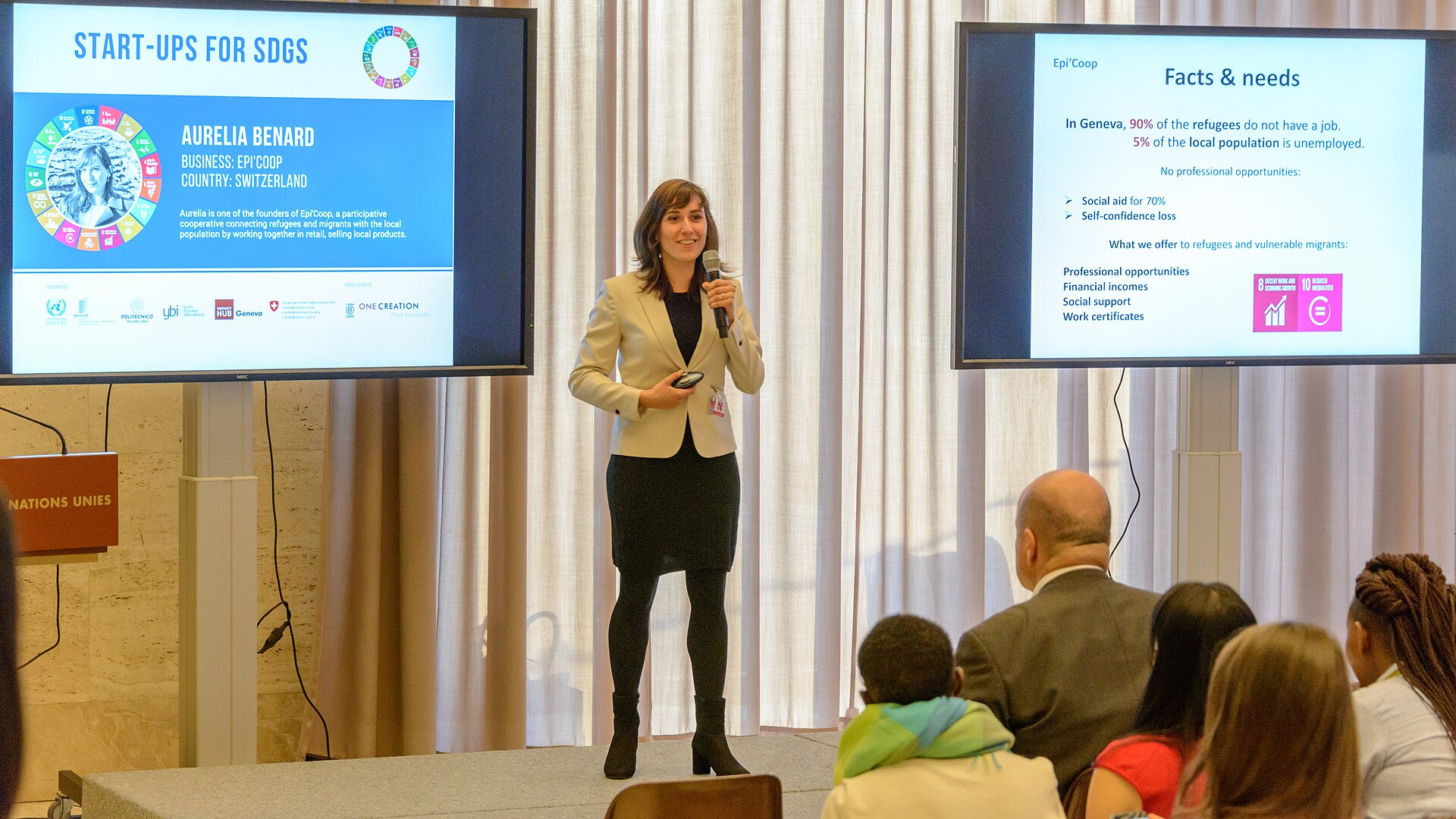
- UNCTAD. Hero image: Aurélia Bernard, one of the founders of Epi'Coop, Switzerland (38383513236).jpg. Wikimedia Commons · CC BY-SA 2.0.Image source ↗
Related Sanctuary capabilities
From analysis to implementation.
Discussion
No approved comments yet.