
Key findings
- The new spatial development strategy framework is most consequential as a delivery-coordination tool: its value will depend on whether authorities turn broad allocations into funded, serviced and commercially viable schemes.
- The near-term private-housing outlook remains fragile. Falling permissions, weaker private new-housing output and restrictive mortgage conditions limit the speed at which additional planning capacity can become starts and completions.
- Infrastructure, public housing and enabling works offer a comparatively resilient source of work, but headline pipelines are signals of future demand—not committed construction orders.
- The practical dividing line through November 2028 will be site readiness: land control, infrastructure capacity, a funding route, a clear delivery owner and a credible sequence of decisions.
- Strategic authorities should manage priority locations as portfolios of dependencies, while SMEs and local providers should position for early works, specialist services and locally structured procurement packages.
The central judgement: planning reform can reduce coordination failure, not eliminate delivery risk
England’s new strategic-planning arrangements arrive at an awkward point in the construction cycle. The Strategic Planning Authorities (Spatial Development Strategy) Regulations 2026 take effect on 26 November 2026 and establish procedures for preparing, examining and publishing spatial development strategies. Their importance lies in creating a framework through which housing, transport, utilities and regeneration can be considered across administrative boundaries. ↗
That is a meaningful institutional change, but it should not be mistaken for an automatic building boom. Planning capacity is only one condition for delivery. A site also needs land control, network capacity, finance, a viable development model, procurement capability and a market able to absorb what is built. If one of those elements fails, a strategic allocation or planning permission may remain an option rather than become a construction programme.
Sanctuary’s central view for late 2026 to November 2028 is therefore selective conversion rather than broad acceleration. The strongest opportunities are likely to sit upstream of major building contracts: site assembly, remediation, utility and transport studies, flood mitigation, business cases, infrastructure phasing and procurement preparation. Housing starts can follow, but only where those tasks resolve the binding constraint and where sales, rental or public funding support the scheme.
This matters because current market conditions make conversion unusually difficult. Construction output fell by 0.7% in the third quarter of 2026; private new-housing output fell by 4.7%; and construction output prices were 3.2% higher than a year earlier. ↗ The Bank of England reported that mortgage approvals for house purchase were down 8% in the three months to September compared with the previous three months. Its November projection had CPI inflation rising to around 5% by mid-2027, while Bank Rate was 4.0% following the Monetary Policy Committee’s November decision. ↗
The implication is not that strategic planning is peripheral. It is that its success should be judged by a tougher measure: whether it converts cross-boundary ambition into funded, serviced and buildable sites quickly enough to withstand an unsettled private-housing market.
Why the new framework matters: it can organise dependencies that local plans cannot resolve alone
The case for spatial strategy is strongest where the constraint is shared. Electricity reinforcement, water and wastewater capacity, strategic transport, flood risk and labour supply rarely follow district boundaries. A framework operating at a wider geography can identify common dependencies earlier, establish a sequencing logic and give public bodies a forum in which to decide who funds and owns the next intervention.
The mechanism is straightforward. A housing allocation creates potential value; coordinated enabling infrastructure reduces uncertainty around that value. Lower uncertainty can improve the quality of a funding case, support landowner and developer decisions, and make procurement more credible. But coordination only creates economic value when it results in an accountable action: a committed network upgrade, an agreed land transaction, a funded remediation package or a procurement timetable.
This is why a spatial development strategy should be treated as a portfolio-management instrument rather than a high-level statement of growth. For every priority site or cluster, delivery partners should be able to identify the critical constraint, the organisation accountable for resolving it, the proposed funding route, the decision date and the evidence that will demonstrate progress. A strategy without this discipline may improve policy alignment while leaving the central delivery risk untouched.
There are early signs of a more active co-delivery approach. In November 2026, Homes England and the National Housing Bank announced Place Delivery Agreements with six strategic authorities, describing shared priority-scheme pipelines and strengthened local oversight. ↗ These agreements should not be counted as homes built or capital committed before individual projects secure approvals and funding. They are, however, a useful leading indicator of institutional intent: they may reduce the transaction costs of aligning public land, finance, infrastructure and local political decisions.
For construction businesses, this shifts attention towards the pre-construction economy. Surveys, design development, environmental and technical studies, programme controls, commercial advice, remediation and utilities coordination may precede larger packages by years. For local authorities, the trade-off is clear: more effort spent on a smaller number of genuinely deliverable schemes may produce more value than maintaining a large but weakly evidenced list of aspirations.
Private housing remains the limiting condition, even where planning becomes faster
The current supply indicators caution against assuming a rapid private-housebuilding recovery. An estimated 212,000 homes received planning permission in England in the year to 30 June 2026, down 12% from 242,000 in the previous year and below the 302,000 recorded in the year to June 2022. ↗ Permissions are not a direct forecast of completions: they are subject to lags, amendments, duplications and non-implementation. Nevertheless, a shrinking permissions flow narrows the stock of future development options.
Planning decision data point to a wider issue than refusal rates. English planning authorities made 74,500 decisions in April to June 2026, down 8% year on year, while 88% of decisions were granted. Residential and commercial major and minor permissions were also lower than a year earlier. ↗ A high approval rate does not prove that the system is frictionless, but it does show why a simple diagnosis of excessive refusal is insufficient. Applicant confidence, build costs, residual land values, mortgage affordability and infrastructure capacity all affect whether an approved scheme proceeds.
Housing delivery has already softened. England recorded an estimated 196,900 net additional dwellings in 2025–26, compared with 208,600 in 2024–25. The provisional figure of 90,200 net additions from 1 April to 20 September 2026 should not be annualised: it is a partial-year indicator, not the final annual measure. ↗
The Construction Products Association’s autumn forecast illustrates the resulting central risk. It expected total construction output to fall by 4.0% in 2026 and grow by only 0.4% in 2027, with private new-housing output declining by a further 3.0% in 2027 after an estimated 10.0% fall in 2026. ↗ This is an industry forecast, not an official outcome, and it should be treated as a scenario input rather than certainty. Its underlying mechanism is nevertheless consistent with the Bank of England evidence: elevated energy costs and mortgage rates can weaken household affordability and project viability at the same time.
The counterargument is that faster, more strategic planning could itself restore confidence. It can help by reducing delay, holding costs and uncertainty. Yet it cannot directly restore borrowing capacity, lower construction costs or create electricity, water and transport capacity where none exists. The relevant test through 2028 is therefore conversion: whether allocated or consented sites move into funded enabling works, starts and sustained build-out.
Infrastructure can cushion the cycle—but a pipeline is not an order book
Infrastructure provides the most plausible counterweight to weaker private development, particularly at the interface between housing and essential networks. Infrastructure new work grew by 3.3% month on month in September 2026 and contributed to a 0.8% rise in overall monthly construction output after four monthly declines. ↗ The Construction Products Association expects infrastructure activity to be supported by energy generation, electricity distribution, water investment and existing long-term contracts, while identifying risks to roads and rail programmes. ↗
The 2026 Budget stated that an updated Infrastructure Pipeline would set out more than £750 billion of planned investment over ten years, alongside an expected workforce requirement of more than 650,000 people. ↗ That is significant as a signal to investors, colleges, suppliers and prospective entrants to the sector. It is not equivalent to a committed order book. Individual schemes still require a settled scope, consent, funding, delivery model, network connection, procurement route and supply-chain capacity.
For places pursuing housing growth, this distinction is critical. Electricity reinforcement, wastewater capacity, flood mitigation, local road improvements, active travel and public transport access are often described as associated infrastructure. In practice, they can form the critical path for development. A strategy that identifies housing land without allocating responsibility and finance for these dependencies has not de-risked delivery; it has deferred the dispute to a later project stage.
Workforce evidence reinforces the need for practical sequencing. CITB projects that the construction workforce will rise from 2.61 million in 2025 to around 2.68 million by 2030, requiring an average of 41,200 additional workers each year between 2026 and 2030. It expects infrastructure and public new housing to be among the faster-growing sectors. ↗ At the same time, construction vacancies fell sharply in 2026. ↗ This need not mean that skills constraints have disappeared; weaker immediate demand can reduce vacancies before major programmes mobilise. The more likely risk is uneven local and occupational scarcity when several programmes draw on the same trades, supervisors and technical specialists.
That creates a direct local-economic case for early workforce planning. Authorities and contractors should connect visible project milestones to colleges, employment providers and local supply-chain development before mobilisation. Doing so can widen access to work and improve retention of local economic value; leaving it until contract award is likely to concentrate opportunity among firms already able to absorb mobilisation risk.
Three scenarios to November 2028—and the signals that would change the view
The base case is selective conversion. Restrictive financing conditions persist through much of 2027, leaving private new housing subdued. Spatial strategies and Place Delivery Agreements improve coordination, but progress concentrates in locations with public-sector partnership, clear infrastructure solutions or resilient local demand. Enabling works, utilities, energy, water, public housing and regeneration preparation outperform highly leveraged speculative housing schemes.
The upside case requires two changes to reinforce one another. First, affordability must improve sufficiently to revive buyer demand and development appraisals. Second, strategic coordination must shorten the time needed to align land, infrastructure and finance. Observable signs would include a sustained recovery in mortgage approvals, stabilising housing permissions, easing construction-cost growth and named strategic sites reaching funded infrastructure procurement. Private starts could then strengthen in late 2027 and 2028, although capacity and network constraints would make that recovery uneven.
The downside case is a prolonged viability shock combined with infrastructure slippage. Persistent energy-price pressure could keep financial conditions tighter for longer; the Bank of England’s adverse-inflation scenario demonstrates that mechanism. ↗ If public programmes are then reprofiled, reduced in scope or delayed, developers may defer starts and contractors may face a weaker flow of awards. In this case, planning capacity could rise while physical delivery falls behind it.
The base case should be revised if the evidence changes. It would be too pessimistic if mortgage approvals recover decisively, permissions stabilise and a growing number of strategic sites secure funded enabling works with credible procurement dates. It would be too optimistic if permissions continue to decline, major programmes are materially reprofiled, or consented sites repeatedly fail to reach enabling works.
A useful dashboard should therefore combine macro and project evidence: mortgage approvals and quoted mortgage rates; permissions and net additions; construction output prices; utility and transport dependencies at scheme level; public funding decisions; procurement notices and awards; and occupational workforce demand in relevant travel-to-work areas. No single target can capture whether a place is actually becoming ready to build.
Sanctuary recommendation: make conversion capability the measure of strategic success
The policy opportunity is real, but the governing question should change. England does not principally need a larger inventory of aspirational sites. It needs a managed portfolio in which every priority site has explicit dependencies, named decision-makers and a credible route to the next irreversible action.
Sanctuary recommends that strategic authorities and their delivery partners establish a conversion board for each priority geography. This should not duplicate the planning committee. Its role is to maintain a live, shared record of which sites could start within 24 months; what prevents each from doing so; the intervention required; the accountable owner; the funding route; and the milestone that will show progress or failure. A concise public version of this record would give local firms, colleges, community organisations and investors time to prepare rather than react.
For developers and contractors, the priority is earlier management of dependency risk. Tender and delivery strategies should distinguish controllable construction risks from unresolved land, utility, consent and client-decision risks. This produces a more realistic allocation of contingency and reduces the tendency for problems outside a contractor’s control to emerge as disputes during mobilisation.
For SMEs, the opportunity is not limited to eventual main works packages. Authorities can preserve local access by breaking work into sensible lots, publishing forward milestones, using proportionate qualification requirements and engaging the market before procurement is fixed. Specialist businesses can then build credible offers around surveys, environmental work, retrofit, remediation, logistics, maintenance, compliance and early works. Such design choices matter for high streets and local enterprise: a visible strategic pipeline has limited local value if its commercial structure excludes local providers from competing for it.
By November 2028, the places with the strongest construction and regeneration opportunity are unlikely to be those with the largest theoretical land supply. They will be those that can demonstrate conversion discipline: funded infrastructure, clear ownership, viable delivery models, workforce preparation and procurement routes that turn strategy into work.
Research foundation
References
- UK Parliament (2026). The Strategic Planning Authorities (Spatial Development Strategy) Regulations 2026. UK Statutory Instruments, 2026 No. 1162.Source ↗
- Office for National Statistics (2026). Construction output in Great Britain: September 2026, new orders and construction output price indices, July to September 2026. Office for National Statistics.Source ↗
- Bank of England (2026). Monetary Policy Report – November 2026. Bank of England.Source ↗
- Homes England and National Housing Bank (2026). Major boost to local housing and regeneration ambitions as regional leaders strengthen co-delivery ties with Homes England and National Housing Bank. GOV.UK.Source ↗
- Ministry of Housing, Communities and Local Government (2026). Housing supply: indicators of new supply, England: April to June 2026. GOV.UK.Source ↗
- Ministry of Housing, Communities and Local Government (2026). Planning applications in England: April to June 2026. GOV.UK.Source ↗
- Construction Products Association (2026). CPA releases Autumn Forecasts 2026. Construction Products Association.Source ↗
- HM Treasury (2026). Budget 2026. GOV.UK.Source ↗
- Construction Industry Training Board (2026). Construction Workforce Outlook: Labour Market Intelligence Report 2026 to 2030. CITB.Source ↗
- Office for National Statistics (2026). Vacancies and jobs in the UK: October 2026. Office for National Statistics.Source ↗
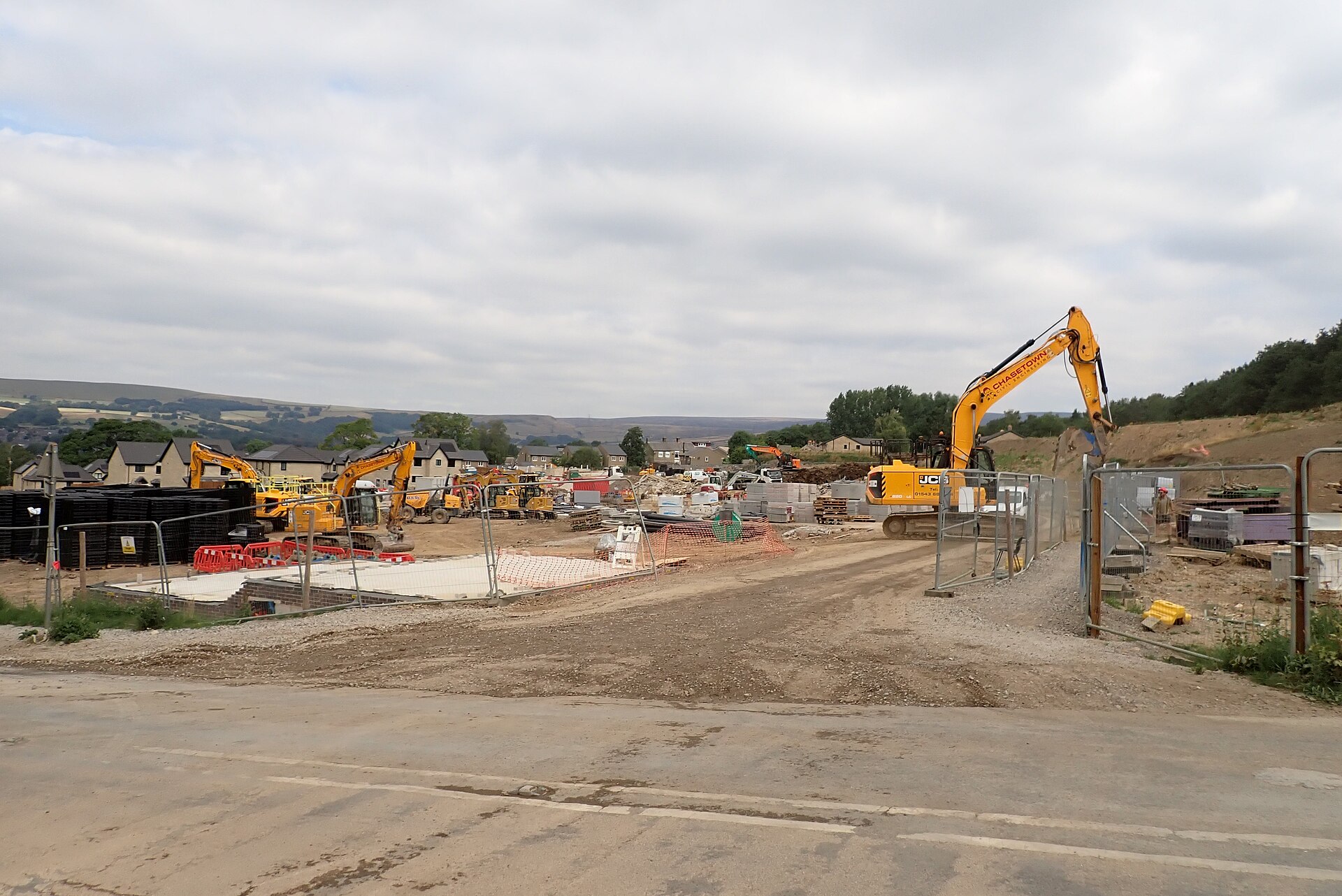
- DS Pugh. Hero image: Construction site along Dinting Road - geograph.org.uk - 8409922.jpg. Wikimedia Commons · CC BY-SA 2.0.Image source ↗
Related Sanctuary capabilities
From analysis to implementation.
Discussion
No approved comments yet.